What is a PhD?
Milojevic et al, “Changing demographics of scientific careers: The rise of the temporary workforce”, PNAS 2018 <Changing demographics of scientific careers: The rise of the temporary workforce>
Colin Percival “On the use of a life, a.k.a., why I am not an academic”, personal blog from 2020. Beautifully written, a lot of specifics about this one individual but universal lesson in there too.
Wang Nature “Owning, not doing: my transition from master’s to PhD student” 2024. Excellent, powerful. Only adjustment I would make is to replace words like “always” and “all” to “almost always” and “almost all”.
Fleming “Top tips for avoiding last-minute disasters and filing your thesis on time” Nature 2018
Taylor “Twenty things I wish I’d known when I started my PhD, Nature 2018. I agree with all of these.
Three published or publishable papers, at least two of which are first-author, makes a PhD. Advancement is when you have a draft of the first paper, and the proposal and proof-of-concept for two more.
There are many equivalences (a high-impact paper probably counts for two; 3 middle-author papers probably count as a first-author paper; a widely-forked software..). Then, the onus is on the Candidate to argue this equivalence.
Different PhD programs have different standards. Different co-advisors have different standards.
Advancement and defence
One of the most fruitful, energizing and empowering activities in science is getting a bunch of smart people in a room and talking about a research project with them. One of my favorite memories from recent years is one time when two senior faculty had a project they were excited about, and they got a few other faculty in a conference room to discuss their project idea. Advancement to Candidacy is one of your opportunities to do this! It is both a time to get smart people’s feedback. It is also stressful because it involves a tonne of work, and because it is a checkpoint to discuss challenges. Here are some tips.
Advancement tips
Projects don’t need to be related.
Co-authored papers can be excerpted, provided you add a suitable Intro and Discussion, and a Statement of Co-authorship
Common pitfall in Advancement presentation: Be clear to distinguish the state of the field and your contribution.
Unlike for papers, the title doesn’t need to actively contain the result.
Executive summary is self-contained. See “Project summary” examples.
For published/submitted papers, copy the tex source and dump it in your Advancement write-up. What was Supp Mat or Appendix can be part of main body.
For unpublished projects, be sure to include
Target results
Preliminary results: at least one figure
How you hope the results address the specific question
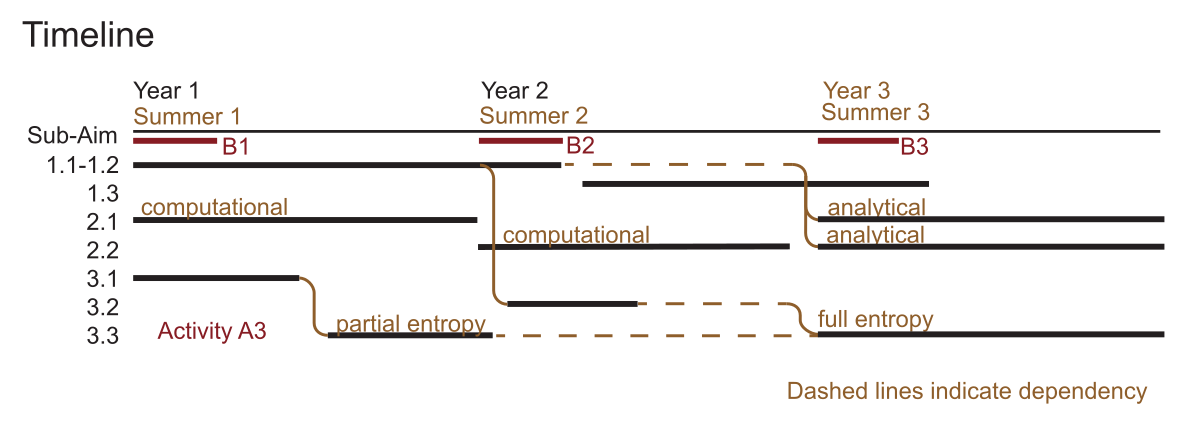
Timeline
Use bibtex and a modern bibliographic tool for References (Mendeley, ReadCube Papers, …).
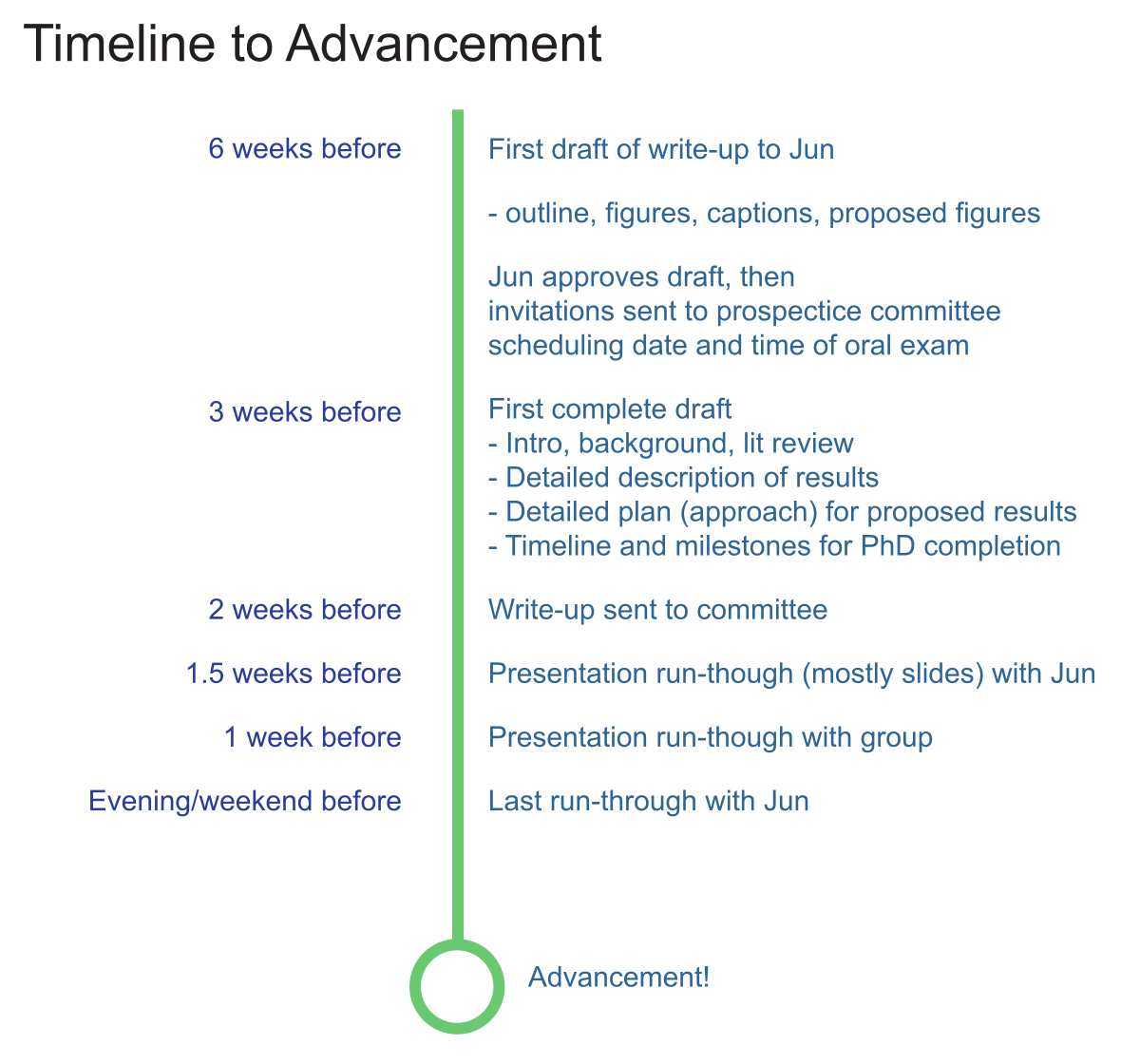
The prototypic timeline
T-minus-6 weeks: First draft of write-up to Jun
Once Jun approves draft:
Invitation sent to prospective Committee members
Scheduling
T-minus 2 weeks:
Write-up sent to Committee
Presentation draft sit-down with Jun
T-minus 1 weeks: Presentation practice with group
Weekend or evening before: Final run-through with Jun
T-minus 0: Advance!
To schedule a meeting, see my old e-mail with tips on scheduling meetings.
Levine “Doctor’s advice” Nature 2016 on choosing a Committee
Quarter reports
It’s easy to get lost in details and short-term milestones, forgetting about the big picture, so we put this in place to force ourselves out of the “urgent-vs-important” trap. The quarter report is an opportunity to think about the big picture. This is a short summary of what you’ve done and are planning to do. It can be as short as 7 sentences, but can be longer.
This quarter I planned to…
I generated the following results…
The main challenges were/are…
I presented my work by/at… (paper submissions, conferences, …)
In addition to my research, this quarter I (took classes, organized a seminar series, TAed, mentored undergraduate or rotation student…)
Next quarter, I plan to…
(If <100%) My percent-effort on these projects was… [This is so we can both keep track of time off for personal reasons, projects with other PIs, classes etc. ]
Put your report in an editable format (Google Doc, latex, MS Word doc), and we will schedule a special slot to go through it together.
This exercise is valuable if it is used for more than a research update, that is, not to show and interrogate new results. (If you have new results that I haven’t seen, then just put it under “6. Next quarter”, for an easy win next quarter!)
Bonus topics you’re welcome to include (in addition to anything else you want to):
For one of my current projects, of all the things that might happen, here is one cool thing, one weird thing, and one bad thing that we could discover:…
A skill or technique I want to learn and teach the group is…
In the own-learn-teach-delegate axes, here is something I want to delegate to Jun/someone else, and something I want to take ownership of:…
