Elements of a scientific contribution
Being an effective scientific communicator
We spend a lot of time on communication, optimizing presentations, poster, paper figures. This is for a few reasons.
Clear thinking means clear communicating, and clear communicating is clear thinking.
Science gains from network effects, but only if each lab/scientist devotes effort to communicating and coordinating. Like a high-performance computer devoting some of its cpu time to parallelization.
The elements
There is a standard layout – time-tested, powerful – for a scientific contribution that works particularly well.
Big question/background
Specific question/hypothesis – what you will deliver in this work
“Here we”
Method
Results, which are usually active sentences, not plots or noun-phrases
Impact
Here are some examples of paper abstracts and layouts:
What paper elements?
Slides with examples of paper layouts.
Approach and gap are of equal importance
“When I sit down with colleagues over a beer at a meeting, we don’t go over the facts, we don’t talk about what’s known; we talk about what we’d like to figure out, about what needs to be done… This crucial element in science was being left out for the students.” - Stuart Firestein (Columbia Neuroscience)
Doing science involves two activities of equal importance:
Identifying the gap in current knowledge/needs
Computational/modeling/experiment approach and carrying out that approach
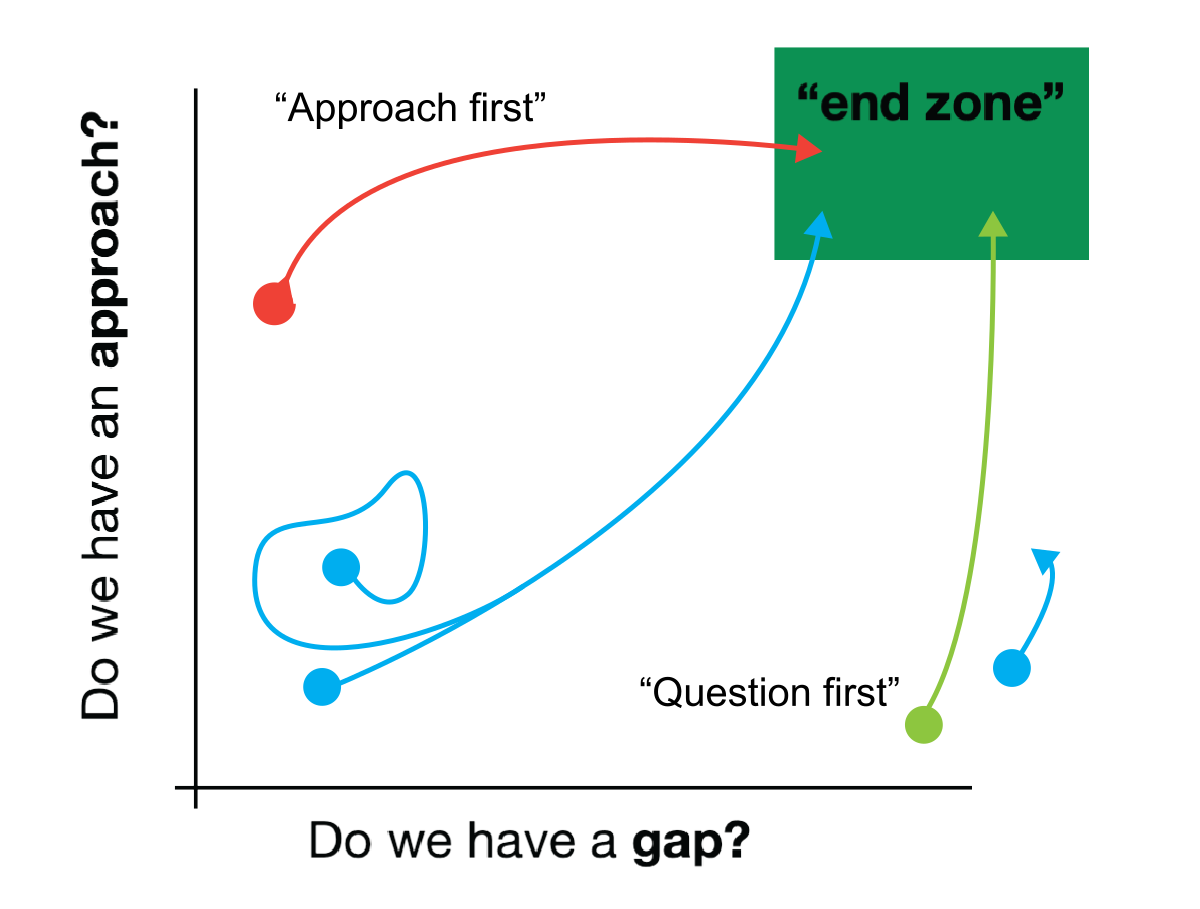
It’s ok to have one before you have the other (exploratory projects, “approach first” projects, “question first” projects,…) and it almost always happens that the approach and gap change throughout a project.
The importance+rigor+time trade-off
A useful coordinate system to “project” (verb) success as a project progresses:
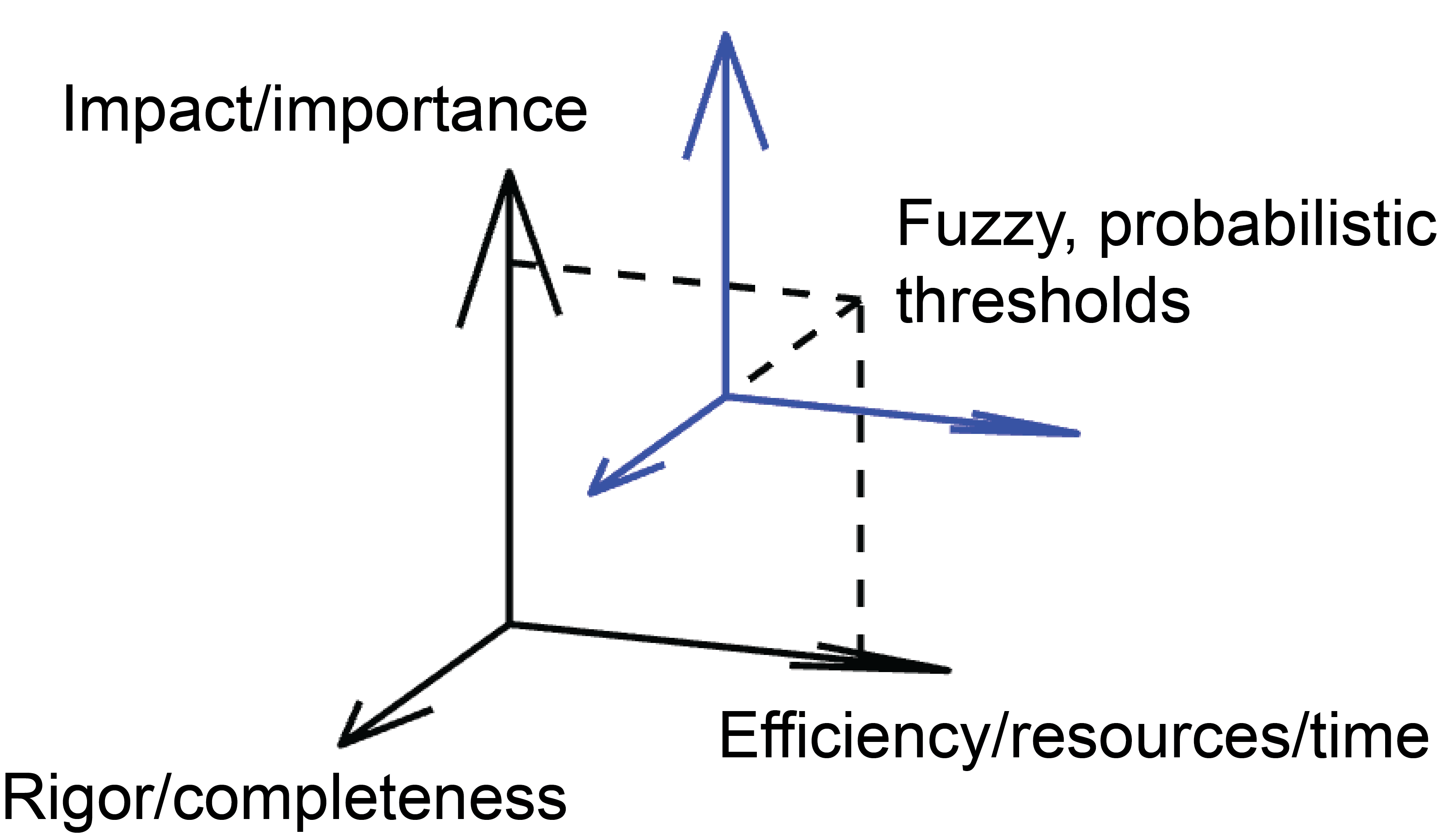
Importance/impact of the result: This importance criteria is often the easiest to retreat on, because there is an attitude in the scientific community that scientists are bad at predicting future importance anyway.
Rigor/completeness/quality. How much did we explore all the “nooks and crannies”, eg parameter sweeps? How much did we reject alternative possibilities? How much did we test the tools? Also in this category is the quality of presentation. How clear do the figures, text, code repositories, tables, communicate the result?
Efficiency/use of resources/speed: Are we going to get this paper done in time, so people can move on to even bigger and brighter things!
There is a fuzzy, probabilistic minimal threshold for each of these.
Above the threshold, there is a trade-off between them. Teams benefit from discussing this trade-off.
Don’t underestimate the value of speed.
Jun’s definition of baseline scientific rigor
Working in multidisciplinary teams has taught me that rigor isn’t a rigid threshold—it’s a flexible, context-dependent standard that adapts to the nature of the question, the tools available, and the intended audience.
So, I have adopted this definition: baseline rigor means accurate, transparent reporting of what was done, what was not done, and what remains uncertain. Think of it like a battlefield journalist in a conflict zone rather than a battlefield general: A journalist’s job is not to win or advance the troops but to report faithfully on its unfolding realities—regardless of whether the war is ongoing, paused, or complete. Similarly, a scientific paper is a snapshot of a project in time: a rigorous paper doesn’t need every question answered or every experiment performed, but it must report an accurate, clear story about the current state of understanding. Speculation is ok, wishful thinking is ok, as long as it is labeled as such.
The science does not need to be complete, but the report needs to be complete.
Using this definition for baseline rigor, this immediately implies a relationship with importance of the result, since by this definition alone, we would publish unimportant/boring/trivial results. So rigor can be paired with, but separated from, the concept of importance. Baseline rigor ensures a scientific report is trustworthy, but importance ensures it’s worth sharing in the first place. A perfectly rigorous but trivial observation adds little to the broader scientific tapestry. Therefore, we aim to meet baseline rigor as a non-negotiable standard while actively engaging with the question of importance. This interplay creates a healthy tension: we strive to report honestly, avoid unnecessary scope creep, and ensure that what we publish contributes meaningfully to advancing knowledge. Balancing these two dimensions is the art—and the joy—of scientific work.
That is, rigor primarily lives in how we report and contextualize our work, not in reaching some mythical state of experimental completeness. This perspective frees us to tackle ambitious, cross-disciplinary questions while maintaining high standards. When we’re uncertain about a result or interpretation, we don’t need to do “just one more experiment” – instead, we can rigorously describe our current understanding and its boundaries. This approach helps prevent the common trap of endless perfectionism while ensuring our work contributes reliably to the scientific record.
A pipeline process requiring different skills and mindsets
Scientific research projects are a pipeline process with many steps. Each step in the process requires a different skillset and a different mindset. (Not “smart”, “hardworking”, “fast”, which are useful at all steps.)
Early, exploratory phase. Skillset and mindset: Ability to accept uncertainty. Curiosity. Ok with lack of rigor. Willingness to try messy, vague things. Let’s just see what happens! “Intentionality” is bad here. A love of learning. Being comfortable with lots of failure.
Rigor phase, “benchwork” phase. Skillset and mindset: Technical rigor. Carefulness. Being well-tempered. At some point here, there must be a transition from “what is the most interesting conclusion” to “how would we show that conclusion?”.
Production phase. Intentionality. Being focused on a single goal, which is to get this thing out the door. Willingness to put aside ideals of ambition. Willingness to put aside ideals of comprehensiveness. Perfectionism is the enemy.
Write-up phase and review phase. Skillset and mindset: (1) Empathy, humility. Put yourself in someone else’s shoes (the peer reviewer, the field, the collaborators,…). To be a “stranger in a familiar land”. Ability to listen to others, and hear both their logical argument and what they aren’t saying. (2) Since the goal is communication rather than impact, some tradeoffs swap completely. Perfectionism in presentation and clarity, at the expense of perfectionism in eg comprehensiveness and completeness. The science does not need to be complete, but the report needs to be complete.
Pipeline steps are “multiplicative” rather than “additive”, meaning that you cannot make up for a deficit in one with being a superstar in another. In a way, the fact that they’re multiplicative is anxiety-inducing, because you must be good at everything. But in another way, it is liberating: You don’t need to be the smartest, the most careful, the hardest working. (Indeed often, you will see people that seem 10x smarter than you, and they can’t get anything done.)
Figures!
What makes a great figure?
Slides about figures.
Upshot: You need the ability to make a figure that is publication grade, informative, and digestible. Not a pixel out of place.
The “Masterful Inaction” principle: it’s ok to make a quick rough figure, as long as you’re doing it because you have the ability to make a publication-quality figure and have deliberately made the decision not to.
For size rules, check out guidelines for some or our favorite journals: PLoS, PNAS, Biophys J, Nature, EMBO. Roughly, the figures are either 19cm or 8.5cm wide, tall enough to fit on a single 8.5”-11” page with their beefy caption, and fonts must be larger than 6pt.
The under-rated power of writing
The paper - meaning a 4-10 page document, written in full sentences, describing a gap in knowledge, a method, a result, and its impact - is a highly-rated and yet still under-rated mode of communication. Nothing compares.
Start the latex doc early! Prototype latex doc that Jun uses personally in this git repo. (This is good for Project Seeds, and papers. Probably not good for thesis.)
A lot of writing will get thrown away as the project evolves. Writing is never wasted, because clear writing is clear thinking.
“When people present an idea in slides, everyone says ‘yaaa that’s greaaaat’. But when you make them write it down in a 1-page proposal, suddenly the problems become clear, and the needed improvement becomes clear.” - Qing Nie, paraphrased by Jun. In many cases in our projects, we have a fantastic presentation (poster or slide deck) about a year before we have a great paper.
“The reason writing a good 4 page memo is harder than ‘writing’ a 20 page powerpoint is because the narrative structure of a good memo forces better thought and better understanding of what’s more important than what, and how things are related.”” Jeff Bezos, quoted in “Write documentation first, then build”. Similar point made by economist and philanthropist Tyler Cowan in “Against slide decks” (I’m not against slide decks though.)
External resources
Creativity as an antidote to research becoming too predictable, Baer et al., EMBO J 2023
“How to slay zombie research projects and move on” Nature 2023
A debate about the importance of communicating your science in Nature 2024
“The code review anxiety workbook”. The first part is a cognitive behavioral therapy-style actionable advice. The second part is mostly about polite e-mail writing.
The
Oxford Biomedical Sciences PhD ("DPhil") proposal guidelines. Especially intruiging is how “specific measurable attainable relevant and time-bound” it emphasizes, compared to open-ended exploration.
Getting to scientific quality / rigor
Overflowing work hours (all-nighters etc) are avoidable. It often feels like there is a crisis, and there is a sudden need to push to make it. This phenomenon is sometimes called “heroics” [1] . The way to avoid heroics begins 10 weeks before a deadline (conference poster or talk, advancement exam, grant submission, paper submission). .. After that, the ball is rolling down a slope.
The time it takes for each step get shorter with (1) experience and (2) trust with the collaborators and with me.
Note many steps involve feedback to previous steps (e.g., in oral part you often realize you need a figure modification). .. So, in true DevOps philosophy, you should plan to revisit every step. .. We have a rigorous imposed timeline when getting ready to present a result to the outside world. .. The time it takes for each step get shorter with experience and trust with the collaborators and with me. In general during a science project, I try to serve as an advisor rather than a gatekeeper, but in terms of communicating and exposing it to the world, here I invoke my prerogative to be more controlling, at least at first.
9: Outline of narrative, i.e., “key sentences” “headlines”; Wishlist of figure and key sentences. Statement of gap that is being filled; wishlist of figures etc that address it.
8: Draft figures with preliminary computation/data and key sentences. This is the proof-of-concept point.
7: Draft figures with publication-grade computation/data and key sentences. Figures are understandable, rigorous. This is the result-production cutoff date.
6: Abstract draft. Decision about whether to submit to the conference. Jun approves draft. Ok to make commitments, e.g., submit an abstract to BPS/ASCB/SIAM, to begin convening Committee for Advancement, …
5: Presentation-grade figures
3&4: Complete (begin to end) slide/poster first draft. Draft of intro, background, lit review. (For posters, Jun requests that paragraphs copied in a separate document e.g., Google doc, for easier editing.) Plan for around 1x-2x rounds of back-and-forth with Jun, from the time of this first complete draft.
3&4: Presentation run-through with Jun. No time-trial. See if everything hangs together. For talks: what slides are needed, how should they be designed? For posters: What’s the layout?
2: Oral practice with audience e.g. Allard Lab. Time trial.
1: Final time-trial practice 1-on-1. For posters, final version to printer. Focus on oral (spoken words); when you’re done the slides, you’re half done, because the spoken words are half the experience.
It’s a slog. Cycling through these steps get faster, and more independent. But the steps never go away. People embarking on their first forays into research take about 1 week per step. (“Are you kidding me, 9 weeks to make a damned poster/talk?!”) A question for you to be always asking yourself: How do you get faster and more independent, as you mature scientifically? When going through this for the first time, I insist on a number of weeks for each step. As you become more experience and I get over my trust issues, the steps accelerate –in some cases a lot! (this acceleration is an honor for me to watch, and one of the single biggest joys in my professional life) – but they sorta never go away.
The above rough guideline of ten weeks to a presentation is related to the rough guideline of ten weeks to a paper.